Waterproof vs Water-Resistant Shoes: The Difference (2026)
What each term really means, how to tell them apart on a shoe before you buy, and which one you actually need for the weather you get.
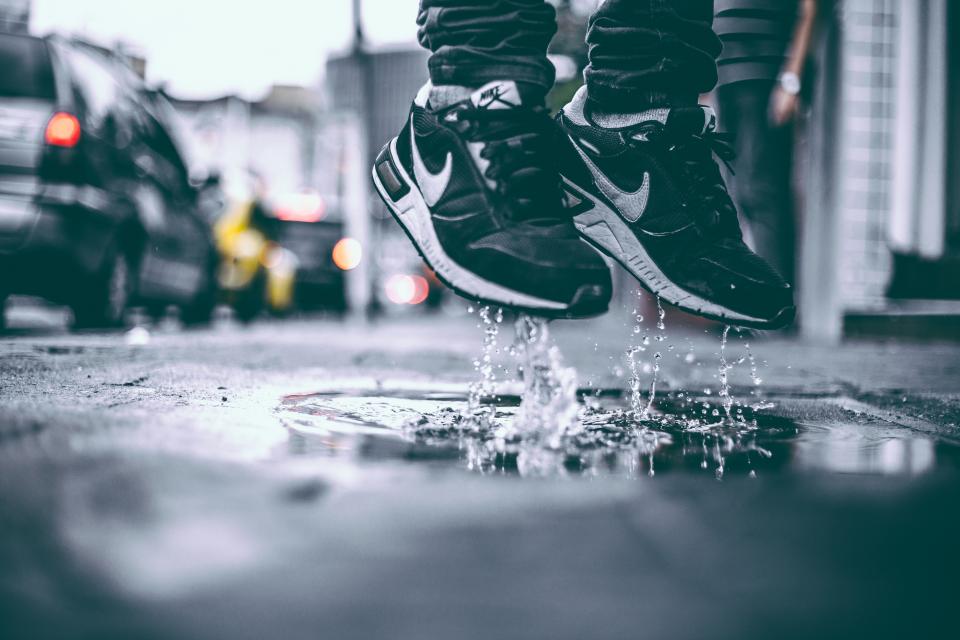
“Waterproof” and “water-resistant” get used as if they mean the same thing. They do not, and the gap between them is exactly the difference between dry feet and a soggy, blister-prone walk home. Here is the plain-English version, plus how to tell which one a shoe really is before you pay for it.
The short answer
- Water-repellent: the surface makes water bead and roll off. Handles a light drizzle. Wears off over time. (Weakest.)
- Water-resistant: resists light rain and splashes for a while, then soaks through. Good for everyday, not for real wet. (Middle.)
- Waterproof: water cannot get in under normal use, because there is a sealed barrier inside. The only true dry-feet guarantee. (Strongest.)
They are three points on one spectrum, from “keeps out a sprinkle” to “keeps out a stream.” The words are not interchangeable, and shoe brands choose them carefully, so you should read them carefully too.
What “waterproof” actually means
A genuinely waterproof shoe has a sealed barrier that liquid water cannot cross:
- a waterproof-breathable membrane bonded inside the shoe (GORE-TEX is the famous one; many brands have their own, shown as GTX, WP, B-DRY, OutDry, and similar), with taped or sealed seams so water cannot sneak in at the stitching, or
- a moulded rubber shell, as on rain boots and wellies, which is waterproof simply because rubber does not let water through.
The one catch that applies to every waterproof shoe: it only keeps water out up to its height. Step in deeper than the collar and water pours in over the top. That is why rain boots are tall and why some people add waterproof socks for extra insurance. It is also why a low-cut waterproof sneaker and a tall waterproof boot are not interchangeable promises: both are “waterproof,” but only one of them survives a puddle over the ankle. If you are shopping for something taller, our guide to the best waterproof boots breaks down which builds hold up in genuinely deep water versus which ones are really just “waterproof” in name.
How waterproof membranes actually work
Most waterproof-breathable shoes are not solid rubber. They use a thin membrane sandwiched between an outer fabric and an inner lining, and understanding that sandwich explains almost every question people have about waterproof footwear.
- The outer layer is usually a woven textile, leather, or synthetic upper. Its job is looks, abrasion resistance, and structure, not keeping water out on its own.
- The membrane sits underneath, and this is the actual waterproof barrier. GORE-TEX and similar membranes (ePTFE or polyurethane based) are full of pores that are, by design, too small for a liquid water droplet to force through under normal pressure, but large enough for water vapor molecules (sweat, as a gas) to escape outward. That is the whole trick: it blocks liquid water in one direction while letting vapor out in the other.
- The lining protects the membrane from the inside, from foot oils, dirt, and wear, and helps wick sweat toward it.
- DWR (durable water repellent) is a separate, thin chemical coating applied to the outer fabric, not the membrane. It is not what makes the shoe waterproof. Its job is to make the outer fabric shed water and bead it up instead of soaking it in. If the outer fabric soaks up water like a sponge (a state shoe geeks call “wetting out”), that wet layer sits against the membrane and blocks vapor from escaping, so the shoe overheats and feels clammy even though the membrane underneath is still 100% waterproof. This is the single most misunderstood part of waterproof gear: a shoe can be fully waterproof and still feel wet and swampy inside once the DWR wears off, because the problem is breathability, not leaks.
That is also why waterproof shoes eventually need reproofing. The membrane itself rarely fails, but the DWR coating on the outer fabric wears off with flexing, dirt, and washing, usually well before the shoe itself is worn out.
What “water-resistant” actually means
Water-resistant shoes rely on tightly woven fabric, treated leather, or a DWR coating to slow water down, not stop it. They shine in light, brief wet: a short shower, wet pavement, morning dew. Push them harder, though, and they give up. Standing water, long wet grass, or a steady downpour will get through, usually starting at the seams and the toe.
Water-resistant has real advantages. It is typically lighter, cheaper, and more breathable than a full waterproof build, which is why a lot of everyday sneakers and even performance water-resistant running shoes stop at water-resistant on purpose. It is a trade-off, not a defect.
What the labels really mean when you’re shopping
Shoe listings throw around a handful of similar-sounding words, and brands are not always consistent about which one they use. Here is what each term is actually telling you, roughly ordered from weakest to strongest:
- “Weatherproof” is the vaguest of all of them and has no fixed technical meaning. It usually implies the shoe holds up to general weather, wind, cold, a bit of damp, but it is not a water claim you can rely on. Treat it as a marketing word, not a spec.
- “Water-repellent” almost always refers to a surface treatment, usually DWR, that makes water bead and roll off. It is about the surface, not the shoe as a whole, and it fades with wear and washing.
- “DWR” or “DWR-treated” is the same idea stated more precisely. If a listing mentions DWR by name, that is a water-repellent finish, not a waterproof membrane. It is a good sign for light rain and a bad sign if that is the only water claim on an otherwise unlined shoe.
- “Water-resistant” is a step up: the material itself (tightly woven fabric, treated leather) slows water down, not just the surface coating. Still not a sealed barrier, and still eventually beaten by sustained wet.
- “Waterproof” is the only word in this list that implies a sealed system, membrane or rubber, plus sealed seams. If a listing does not name a membrane or construction anywhere in the description, be skeptical of the word “waterproof” sitting alone in a title, since some listings use it loosely.
A useful shortcut: the more specific and technical the language (named membrane, taped seams, denier ratings, hydrostatic head numbers), the more likely the claim is real. The vaguer and more feel-good the language (“weatherproof,” “repels rain”), the more likely you are looking at water-resistant at best.
How to tell them apart before you buy
- Read the exact word. “Waterproof” is a specific claim. “Weatherproof,” “water-repellent,” “DWR,” or “water-resistant” are not the same thing.
- Look for a named technology. A real waterproof shoe names its membrane or construction (GORE-TEX, GTX, WP, OutDry, moulded rubber). Silence usually means water-resistant at best.
- Check the seams. Taped or sealed seams point to waterproof; open stitching that water can wick into points to water-resistant.
- Consider the material. Full-grain treated leather and rubber resist water well; mesh and untreated suede do not.
Which one should you buy?
Match the shoe to the wet you actually face:
- Everyday, light rain, city commute: water-resistant is often plenty, and you get better breathability and a lower price.
- Hiking, trails, wet grass: go waterproof. See our best waterproof hiking shoes.
- Snow, slush, deep cold: waterproof and insulated. See our best waterproof winter boots.
- Puddles, storms, downpours: waterproof, tall. See our best rain boots for women and for men.
- Work sites and standing in the wet: waterproof work boots. See our best waterproof work boots.
Real-world scenarios: which one do you actually need
The category names above are useful, but most people are really trying to answer a narrower question: “for what I actually do this week, which do I buy?” Here is how it breaks down by activity.
- The daily commute (walking, bus stop, train platform): you are outside in short bursts, usually on pavement, and a lot of that “rain” is really just damp air and spray off passing cars. Water-resistant is usually the right call here. It is lighter for walking all day and you rarely stand in it long enough for water to fully soak through.
- Walking the dog, twice a day, in all weather: this one tips toward waterproof, because you cannot pick your weather window and wet grass at 7am behaves like standing water. If your dog walks take you off pavement onto grass or trail edges, waterproof earns its keep fast.
- Hiking and trail use: waterproof, close to non-negotiable. Wet grass, stream crossings, and mud do not care how tightly woven your fabric is. Check our best waterproof hiking shoes guide for picks built specifically for this.
- Snow and deep cold: waterproof and insulated together, since snow melts against warm boots and behaves like standing water the moment it does. See best waterproof winter boots.
- Work sites, warehouses, standing water, wet concrete: waterproof, full stop, ideally with the safety-rated soles and protective toes covered in our best waterproof work boots guide. This is one of the few categories where water-resistant is genuinely the wrong purchase, not just a lesser one.
- Festivals, concerts, and outdoor events: it depends entirely on the venue and season. A dry summer field can get away with water-resistant sneakers; a muddy autumn festival is a waterproof-boot situation, and a lot of festival regulars simply keep a tall pair of rain boots for exactly this.
The rule of thumb: if wet feet would merely be annoying, water-resistant is fine. If wet feet would ruin your day, buy waterproof.
The breathability trade-off, in depth
“Waterproof shoes run hot” is not a myth, it is physics. Any barrier that stops liquid water from getting in also, to some degree, slows down how fast sweat vapor and warm air can get out, even with a good membrane doing its best to let vapor pass. A few things follow from that:
- Waterproof shoes are almost always warmer than an equivalent water-resistant or unlined shoe, foot temperature climbs faster, especially in the first 30 to 60 minutes of wear before the shoe “breathes in” a bit.
- This matters most in warm, dry conditions. A waterproof hiking shoe worn on a hot, dry summer trail with no real wet underfoot is arguably the wrong tool: you are paying the breathability tax without collecting the payoff. This is exactly the scenario where water-resistant or even unlined shoes with good ventilation are the smarter pick.
- It matters least in cold or wet conditions, where the extra warmth of a waterproof build is a bonus, not a downside, and keeping water out matters more than venting heat.
- Sock choice changes the equation. A thin, wicking sock under a waterproof shoe manages sweat far better than a thick cotton sock, which just holds moisture against the foot. Pairing waterproof shoes with the wrong socks is a common reason people wrongly blame the shoe for feeling clammy.
- “Breathable waterproof” is a real, meaningful spec, not just marketing. Membranes vary in how much vapor they let through per day, so two waterproof boots can feel very different on a warm hike even though both technically keep water out equally well.
The short version: waterproof buys you dry feet at the cost of some warmth and airflow. Water-resistant gives up some of that dryness in exchange for a cooler, lighter shoe. Neither is objectively better, it depends on which discomfort you would rather avoid on a given day.
Durability and lifespan: how each type fails
Waterproof and water-resistant shoes do not wear out in the same way, and knowing the failure pattern helps you spot the end coming before you get caught out in it.
- Waterproof shoes usually fail at the seams and flex points first, not across the membrane itself. Repeated flexing at the ball of the foot, combined with dirt working into stitching, is the most common place a waterproof shoe starts to leak. The membrane itself, if it is a quality one, often outlasts the rest of the shoe.
- The DWR coating fades long before the membrane fails. This is the most common source of “my waterproof boots stopped being waterproof” complaints, when really the membrane is fine and the outer fabric has just stopped beading water, so it wets out and feels wet from the outside in even though no water actually reached your foot.
- Rubber rain boots fail differently, usually by cracking or delaminating at flex creases after repeated bending, particularly in cold weather when rubber stiffens up. A crease crack at the forefoot is the giveaway that a rubber boot’s waterproofing is compromised.
- Water-resistant shoes fail more gradually and less dramatically. There is no single membrane to puncture, so performance just slowly declines as the fabric weave loosens, the DWR wears off, and the material itself starts to absorb rather than shed water. You will not get one dramatic leak, you will get “these do not keep my feet dry the way they used to.”
- Leather (treated or untreated) sits in between. Good full-grain leather with regular conditioning resists water well for years, but it needs upkeep; neglected leather dries out, cracks, and loses whatever resistance it had.
Neither category is “more durable” in an absolute sense, waterproof shoes protect against wet longer per outing but the coating needs upkeep, while water-resistant shoes degrade more predictably and cheaply over time.
Cost comparison
Waterproof construction genuinely costs more to make, and that shows up at the register:
- Membranes cost money. Licensing a name-brand membrane like GORE-TEX, plus the extra manufacturing steps (bonding the membrane, taping every seam), adds real cost that gets passed on. A waterproof version of a shoe is routinely 20 to 40 percent more expensive than the same shoe in a non-waterproof or water-resistant build.
- Water-resistant treatments are cheap by comparison. A DWR spray coating or a tightly woven fabric adds little to manufacturing cost, which is part of why water-resistant sneakers and running shoes can stay affordable while still offering real (if limited) protection.
- Ongoing cost matters too. Waterproof shoes need occasional reproofing products to keep the DWR working, an added cost most people do not budget for. Water-resistant shoes benefit from the same products but are less reliant on them to function at all.
- Rubber rain boots are the budget-friendly waterproof option, since a moulded rubber shell needs no membrane or taping and is comparatively cheap to produce, which is why tall rain boots are often the least expensive fully waterproof footwear you can buy.
If budget is tight and your wet exposure is mild, water-resistant gets you real, meaningful protection for a lot less money. If you need guaranteed dry feet, the waterproof premium is buying you something water-resistant cannot deliver at any price: a sealed barrier.
How to maintain each type
Both categories need care, just different kinds.
Maintaining waterproof shoes:
- Clean off dirt and grit regularly, since built-up grime works into seams and accelerates DWR breakdown.
- Reapply a DWR spray every few months of regular wear, or as soon as you notice the outer fabric soaking up water instead of beading it. A dedicated waterproof spray for shoes restores that beading effect and protects the fabric above the membrane.
- Let shoes air dry away from direct heat. High heat can damage membrane adhesives over time, ordinary air drying does not.
- Check seams periodically for lifting tape or fraying stitching, small problems here are cheap to catch early and expensive to ignore.
Maintaining water-resistant shoes:
- Reapply DWR spray more often than you would with a waterproof shoe, since it is doing more of the overall work here, not just protecting a membrane.
- Condition treated leather uppers to keep the material supple and resistant to cracking; a suede protector spray is the right call specifically for suede and nubuck uppers, which need a different treatment than smooth leather.
- Avoid machine washing unless the care label explicitly allows it, since washing strips DWR coatings fast.
- Accept the limits. No amount of maintenance turns a water-resistant shoe into a waterproof one, upkeep restores it to its original (limited) performance, it does not upgrade it.
Common myths and buyer mistakes
- “Waterproof means it will never leak.” Not true over the long term. DWR wears off, seams age, and rubber cracks. Waterproof means sealed when new and well maintained, not sealed forever with zero upkeep.
- “If my feet feel damp, the shoe must be leaking.” Often false. Damp, clammy feet in a genuinely waterproof shoe are usually a breathability issue (sweat that could not escape) rather than water getting in. Feel for actual liquid water, not just warmth or dampness, before concluding the shoe has failed.
- “Water-resistant and waterproof are basically the same thing, marketing fluff.” They are not. This is the single costliest assumption buyers make, because it leads people to buy water-resistant shoes for waterproof-shoe situations (hiking, snow, standing water) and end up with soaked feet.
- “A higher price always means better waterproofing.” Price tracks brand, materials, and styling as much as it tracks the actual waterproof construction. Always check for the named membrane or sealed-seam construction rather than assuming cost equals protection.
- “Spray-on waterproofing makes any shoe waterproof.” Sprays restore or add water-repellency (DWR-level protection), they do not create a sealed membrane. A treated mesh sneaker is a better water-resistant sneaker after spraying, it is still not a waterproof shoe.
- “Once it says GORE-TEX, breathability does not matter.” Membrane brand tells you it is genuinely waterproof, but breathability still varies by membrane type and shoe design, so it is worth checking both claims separately rather than assuming one guarantees the other.
When water-resistant is actually the smarter buy
It is easy to read a comparison like this and conclude waterproof is simply the better shoe. It often is not, for a specific and common set of buyers:
- You mostly deal with light, short exposure to wet, commuting, running errands, occasional drizzle, not standing water or sustained rain.
- You want lighter, more breathable footwear for long days on your feet, especially somewhere warm, where a waterproof build would leave your feet overheated more often than it kept them dry.
- You are budget-conscious and would rather spend the savings on a spray treatment or better socks than on membrane construction you will rarely need at full strength.
- You already own good waterproof boots for the serious wet and just need a second, lighter pair for everyday use, in which case duplicating waterproof construction is wasted money.
- You care about all-day comfort more than worst-case protection, and would rather have a cooler, more flexible shoe most of the time than a warmer, stiffer one “just in case.”
In these cases, a well-made water-resistant shoe, kept fresh with the occasional waterproofing spray, is not a compromise, it is the correct tool for the job.
The rule of thumb: if wet feet would merely be annoying, water-resistant is fine. If wet feet would ruin your day, buy waterproof. And if you already own shoes you love that are only water-resistant, you can push them a bit further at home with a waterproofing spray, which we walk through in how to waterproof shoes at home.
Frequently asked questions
Is water-resistant the same as waterproof?
No. Water-resistant means a shoe can shrug off light rain, splashes, and brief contact with water for a while before it soaks through. Waterproof means water cannot get in at all under normal use, because the shoe has a sealed barrier (a membrane like GORE-TEX, or a moulded rubber shell). Think of it as a spectrum: water-repellent is the weakest, water-resistant is in the middle, and waterproof is the strongest and only true 'dry feet' guarantee.
Can water-resistant shoes get wet inside?
Yes. Water-resistant shoes buy you time, not immunity. In a light shower or on dewy grass they keep your feet dry for a while, but stand in a puddle, walk through long wet grass, or get caught in steady rain and water will eventually work through the material or come in over the top. If staying dry is non-negotiable, you want waterproof, not water-resistant.
How can you tell if a shoe is actually waterproof?
Look for a named waterproof membrane or construction, not just the word 'water-resistant.' Genuine signals include GORE-TEX or a brand's own membrane (often shown as GTX, WP, B-DRY, OutDry, or 'waterproof' in the model name), fully taped or sealed seams, and a moulded rubber shell on rain boots. Vague marketing like 'weatherproof,' 'water-repellent,' or 'DWR treated' usually means water-resistant, not waterproof. When in doubt, check whether the maker explicitly says 'waterproof' and names the technology.
Does waterproof mean the shoe is also breathable?
Not automatically. A moulded rubber rain boot is fully waterproof but barely breathes, so feet can get sweaty. A waterproof-breathable membrane like GORE-TEX is designed to block liquid water from outside while letting sweat vapour escape, so it stays far more comfortable. If you will wear the shoe for long or in warm weather, look specifically for a waterproof-breathable membrane rather than solid rubber or coated fabric.
Is water-repellent better than water-resistant?
It is usually weaker. Water-repellent (often a DWR, or durable water repellent, coating) makes water bead up and roll off the surface, which handles a light drizzle. But the coating wears off with use and does not stop water once the fabric is saturated. Water-resistant materials resist a bit longer, and waterproof shoes stop water entirely. The order from least to most protective is: water-repellent, water-resistant, waterproof.
Which do I need, waterproof or water-resistant?
Match it to the wet you expect. For everyday city wear, light rain, and the occasional splash, water-resistant is often enough and usually lighter and more breathable. For hiking, snow, deep puddles, wet grass, work sites, or anywhere you cannot afford wet feet, choose waterproof. A simple rule: if getting your feet wet would ruin your day, buy waterproof.