Best Rain Boots (2026): Tested Picks for Women, Men & Kids
Tall wellies, ankle chelseas, insulated winter pairs, wide-calf fits, and kids' boots: one tested pick for every wearer and every kind of wet.
Rain boots are the rare piece of footwear where the cheap option genuinely works. A moulded rubber welly has no seams to leak and no membrane to wear out, so it is waterproof by construction rather than by treatment, and a twenty-dollar pair keeps your feet as dry as a designer one. What actually separates good from bad is everything around the waterproofing: whether the sole grips wet pavement, whether the shaft fits your calf, whether it is warm enough for the weather you own it for, and whether the rubber survives more than one season.
So this page is organised by wearer and by situation rather than by price. Below are our picks across the whole category: the classic tall welly, the practical insulated boot, kids’ boots, ankle chelseas, a budget pair worth owning, and a genuinely wide-calf option. For a deeper list in one direction, we have dedicated guides to women’s rain boots, men’s rain boots, and kids’ and toddler rain boots, plus a Hunter brand guide if you have already settled on the name everyone knows. At the opposite end of the price range, our guide to Chanel rain boots covers what the designer pair really costs and which boots get you the same look for a fraction of it.
How we picked
Waterproofing is close to a given in this category, so it was the floor rather than the differentiator. We ranked on the things that actually vary: traction on wet, smooth surfaces, which is where most rubber outsoles are weakest; calf and foot fit, the single most common reason a rain boot gets returned; warmth, since an uninsulated welly is genuinely cold below freezing; and durability, meaning how the rubber holds up at the instep flex point where boots crack first. Every pick is a real, currently available boot with a substantial owner base behind it, scored on the same five criteria we use across the site.
Rubber, neoprene, or PVC
The material decides how the boot ages and how it feels in the cold, and it is the one specification worth understanding before you buy.
Natural rubber is what the classic wellies use. It is the best material for flexibility and feel, it stays supple in cold weather, and it takes a high-gloss finish. It also oxidises: the pale bloom that appears on an older pair is harmless and wipes off, though prolonged sun and heat will eventually crack it.
Neoprene-backed rubber, as on the Bogs, adds an insulating layer between the rubber shell and your foot. This is what makes a boot genuinely warm rather than merely waterproof, and it is why an insulated pair is worth the premium if your winter is wet as well as cold.
PVC is the cheapest option and is completely waterproof, but it is stiffer, noticeably colder, and far more prone to cracking at flex points after a season or two. It is fine for a boot you expect to replace; it is not the material to buy if you want the pair to last.
Height: tall, mid, or ankle
Height is a coverage-versus-wearability trade, and most people buy the wrong end of it at least once.
A tall welly covers you to just below the knee. It is the only height that genuinely handles deep puddles, wet grass, and mud, and it is what you want for gardening, dog walking, festivals, or anywhere the water is above your ankle. The cost is bulk, warmth in mild weather, and the calf-fit problem below.
A mid or ankle boot stops at or just above the ankle. It is far easier to wear with normal clothes, easier to get on and off, and much less conspicuous on a commute, which is why the chelsea shape has taken over city rain footwear. It handles rain falling on you perfectly well; it does not handle water you step into.
The honest guidance: if your wet weather is pavement and a walk from the car, buy the ankle boot and you will actually wear it. If you regularly stand in the wet, buy tall.
The calf-fit problem
This is the most common reason a tall rain boot disappoints, and it is worth checking before you order rather than after. Unlike a leather boot, a moulded welly has one fixed shaft circumference and no laces to let it out, so if your calf is near the limit the boot simply will not close comfortably, and it will not stretch meaningfully with wear.
Measure the widest part of your calf, then check the boot’s stated shaft circumference rather than assuming. Hunter’s classic tall boot in particular runs slim, which catches a lot of buyers by surprise. If you are above roughly sixteen inches, look for a boot designed for it: an expandable rear gusset like the Jileon Extra Wide Calf fits up to around twenty inches, and an adjustable back panel is far more reliable than hoping a standard pair gives.
Also remember you will wear a thicker sock in these than in shoes. If you are between sizes, size up, and consider a pair of waterproof socks if you are prone to cold feet.
Traction, and why rubber can be slippery
The weak point of a classic welly is grip on smooth wet surfaces. Deep lugs are designed for mud and soft ground, and on wet tile, painted concrete, or a metal ramp a lugged rubber sole has far less contact area than a flat rubber outsole does. Cold makes it worse, because standard rubber stiffens as temperature drops and a stiffer compound grips less.
If your wet weather is urban, prioritise a boot with a flatter, siped outsole over an aggressive lug pattern. If it is rural, the lugs are the point. And if you are walking on ice rather than water, a rain boot is the wrong tool: see our best waterproof snow boots instead.
Which boot for what you actually do
Most buying mistakes here are not about quality, they are about buying for the wrong activity. The same boot that is perfect in a muddy paddock is miserable on a train platform.
The commute. You want ankle height, a flat and siped outsole, and something that does not announce itself with your work clothes. A chelsea like the Hunter Original Chelsea or the Chooka Delridge is the right shape. Tall wellies are overkill for pavement, awkward to store under a desk, and hot indoors.
Dog walking and the school run. This is the classic tall-welly case: wet grass, unpredictable puddles, and twenty minutes at a time. Coverage matters more than style, and easy on-and-off matters more than either, because you will be doing it twice a day in a hurry. Your boots will handle the walk; the dog is the other half of the mess, and if a soaked, muddy one goes straight into the back of the car afterwards, our sister site Pawtoro covers dog car seat covers.
Gardening and yard work. Prioritise the sole and the shaft. You need lugs for soft ground and a boot you can hose down, and you will be kneeling and flexing the instep constantly, so this is where cheap PVC cracks first. An insulated neoprene-lined boot is worth it here even in mild weather, because standing still on cold wet soil pulls heat out of your feet fast.
Festivals and mud. Tall, cheap enough that you are not precious about it, and grippy. This is the one case where a lower-cost pair is genuinely the smarter buy, because deep mud will scuff and stain whatever you wear.
Real outdoor work. Insulated, tall, and built for it, which is where the Bogs sits. Pull-on handles stop mattering right up until your hands are cold and wet, and then they matter a great deal.
Insulation, and what the numbers mean
Rain boot insulation is described in a few different ways, and they are not interchangeable.
Neoprene thickness in millimetres, typically 3mm to 7mm, is the most useful figure on a lined rubber boot. More neoprene means more warmth and more bulk. It also insulates when wet, which is why the material is used for wetsuits and why a neoprene-lined boot stays warm after a soaking that would render a fabric lining useless.
Temperature ratings in degrees are marketing-adjacent and worth treating with scepticism. They usually assume you are moving, wearing a decent sock, and not standing still. Read a rating as a comparison between two boots from the same brand rather than as a promise about a specific morning.
Uninsulated is the default for a classic welly, and it is a genuine limitation rather than an oversight. A plain rubber boot is essentially a waterproof tube with no thermal barrier, so in freezing weather your feet get cold quickly no matter how good the boot is. A thick wool or waterproof sock closes most of that gap for a fraction of the cost of a second pair of boots.
Rain boots or waterproof shoes?
Worth asking before you buy, because a lot of people buy a welly for weather that does not need one. A rain boot’s advantage is total coverage and total sealing, and its disadvantage is that it is a rubber tube: uninsulated, unsupportive over distance, and not something you want to walk five miles in.
For everyday wet weather where you are mostly walking rather than standing in water, a waterproof shoe or boot is more comfortable and more versatile, and our best waterproof boots guide covers those. Buy the rain boot for standing water, mud, and downpours; buy waterproof shoes for the daily commute.
Care, and making a pair last
Rubber boots ask very little, but the little they ask matters.
Rinse mud off rather than letting it dry on and flex the rubber as it cracks. Dry them at room temperature, never on a radiator or in direct sun, because heat and UV are what age rubber fastest. Store them upright rather than folded at the ankle, since a permanent crease at the instep is where a boot eventually splits. If a natural-rubber pair develops a pale bloom, that is oxidation rather than mould: wipe it off with a damp cloth, or use a rubber buffer to restore the shine. None of this applies to the waterproofing itself, which does not degrade the way a membrane or a DWR coating does, and so needs no re-treatment spray.
The bottom line
Buy the Hunter Original Tall if you want the classic and your calves suit it, the Bogs Classic Ultra High if your wet weather is cold or involves real work, the Kamik Stomp for kids, the Hunter Original Chelsea if you want something you will actually wear on a commute, the Chooka Delridge if you want most of that for a fraction of the money, and the Jileon Extra Wide Calf if standard wellies have never fit your calves. Whichever you pick, the waterproofing is the easy part - fit is what decides whether you keep wearing them.
How we test waterproof shoes
Every pick is scored on the same five criteria and cross-checked against real owner feedback - so the ranking reflects how a shoe holds up, not its spec sheet.
Waterproofing
How well it seals - GORE-TEX, eVent, or a quality liner, with gusseted tongues and taped seams.
Traction
Outsole compound and lug pattern, and real grip on wet rock, gravel, and slick mud.
Support
Midsole stiffness, torsional rigidity, and stability on uneven ground and under a pack.
Comfort
Fit and width options, cushioning, break-in, and weight over long days.
Durability
Upper toughness, toe and heel protection, and how it holds up season after season.
Best overall
Hunter Original Tall (Women's, Gloss)
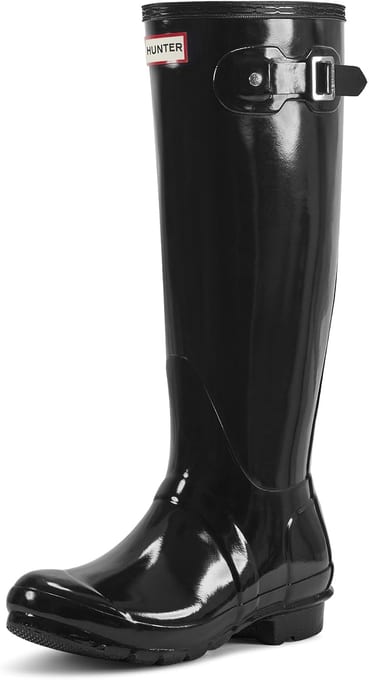
The boot everything else gets compared to. Handcrafted from twenty-eight pieces of natural rubber and vulcanised, so it is waterproof by construction with no seams to fail, and the high-gloss finish is the look most people picture when they think rain boot. It is not the lightest or the warmest welly here, and the calf runs famously slim, but for pure rain in a shape that never looks dated it is still the benchmark.
Pros
- Handcrafted, fully waterproof natural rubber
- Iconic glossy silhouette
- Huge owner base and proven longevity
Cons
- Runs slim through the calf
- Uninsulated, so cold in freezing weather
Best for men and cold, wet work
Bogs Classic Ultra High (Men's)
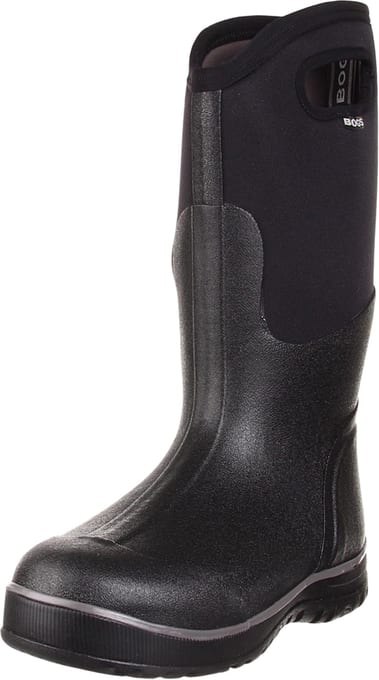
The most practical boot on this page. A one-piece waterproof rubber shell over a neoprene upper, insulated well below freezing, with pull-on handles and an outsole that actually grips wet ground rather than skating over it. This is the boot for anyone whose wet weather involves mud, livestock, or a job site instead of a commute, and the comfort scores reflect a boot people wear all day rather than for a dash to the car.
Pros
- Insulated for genuine cold
- Grippy outsole on mud and wet ground
- Easy pull-on handles
Cons
- Bulkier than a slim welly
- Too warm for mild rain
Best for kids
Kamik Stomp
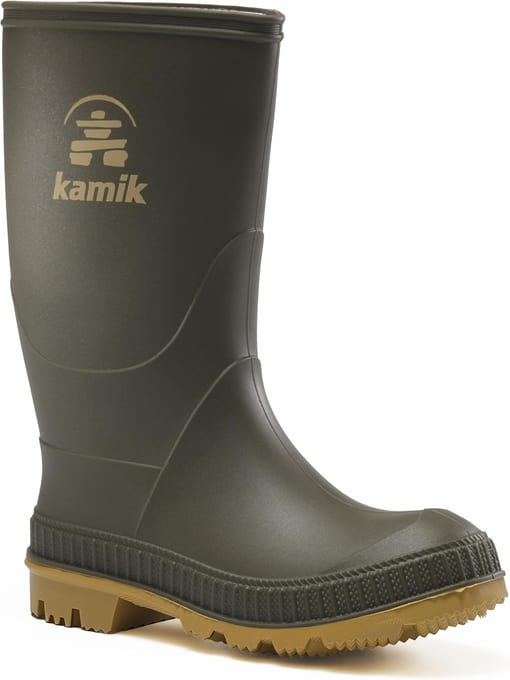
A properly built kids' welly rather than a novelty one. Waterproof rubber with a warm felt footbed, a grippy sole for wet playgrounds, and a wide opening small feet can actually get into without a parent wrestling them. Thousands of owners and a rating that holds up, which for kids' footwear usually means it survives a full season of the exact abuse you are imagining.
Pros
- Warm felt footbed
- Easy on and off for small feet
- Grippy sole for wet playgrounds
Cons
- Plainer than character boots
- Sized for growing room, so check the chart
Best ankle boot
Hunter Original Chelsea (Women's)
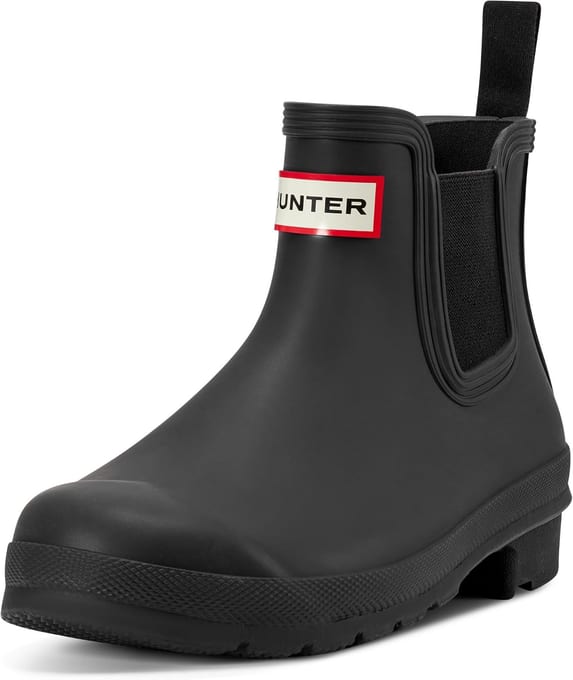
The Hunter for people who do not want to look like they are headed to a field. Same vulcanised natural rubber as the tall boot in an ankle height with elastic side gussets and a rear pull tab, so it slips on and pairs with jeans instead of dictating the outfit. You trade rain coverage for wearability, which is the right trade if most of your wet weather is pavement rather than puddles.
Pros
- Sleek, versatile ankle height
- Slips on with elastic gussets
- Pairs with everyday clothes
Cons
- Runs small; size up
- Least rain coverage of the line
Best value
Chooka Delridge Chelsea Rain Boot
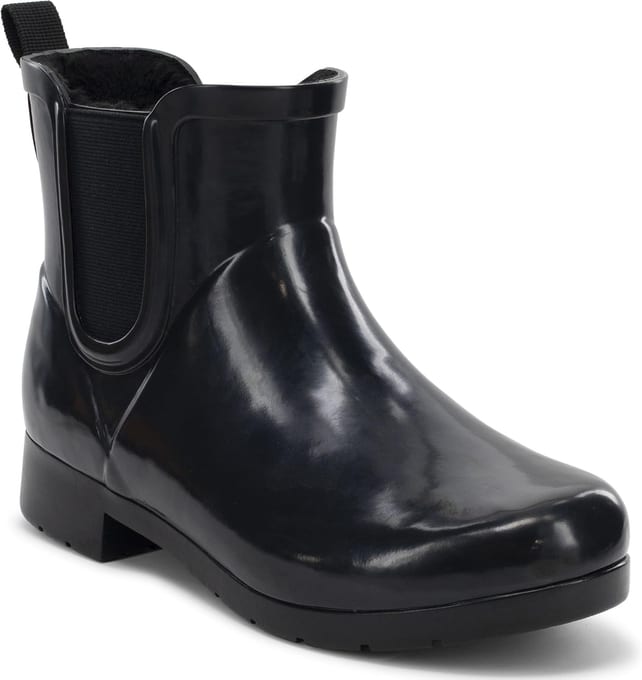
Proof that you do not need to spend much to keep your feet dry. A 100% waterproof vulcanised rubber chelsea with a faux-fur lining and a memory-foam insole, so it is warmer and comfier underfoot than the price suggests, with a quilted look that reads far more expensive than it is. Ten thousand owners agree. It runs small, so size up.
Pros
- Lined and cushioned for the money
- Quilted, put-together look
- Very large, consistent owner base
Cons
- Runs small; size up
- Ankle height limits coverage
Best for wide calves
Jileon Extra Wide Calf Tall Rain Boot
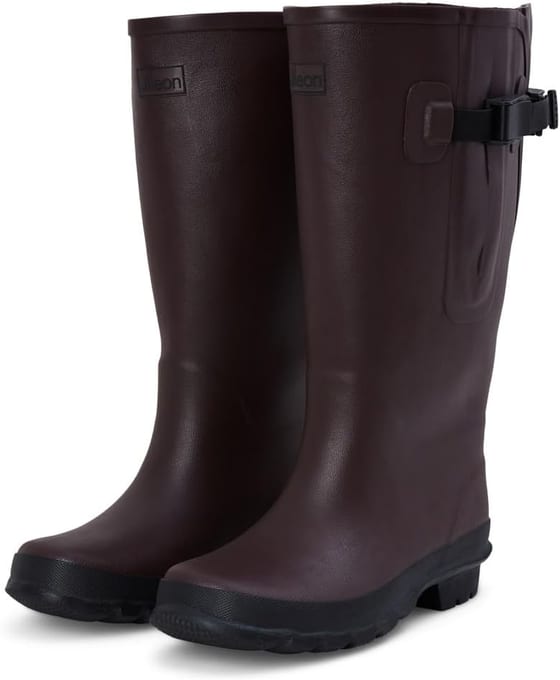
The answer to the most common complaint about tall wellies. A fully waterproof rubber boot with a rear-expansion gusset that fits calves up to about twenty inches, plus room through the foot and ankle, where a standard tall boot stops several inches short. It is function-first rather than fashion-first, but if a snug shaft is what has ruined rain boots for you, this is the one that fits.
Pros
- Rear expansion fits calves to ~20 in
- Roomy through foot and ankle too
- Fully waterproof rubber
Cons
- Utilitarian rather than glossy
- Runs large per some owners
Also worth considering
Strong, well-reviewed shoes that just missed our ranked list - worth a look if the picks above aren't quite right for you.
- Kamik Jennifer Tall - The classic buckled tall welly at a budget price, with clean lines close to the Hunter silhouette and one of the largest review counts of any rain boot.
- Joules Molly Welly - A glossy natural-rubber welly in heritage prints with a signature side buckle: the playful, printed take on the tall boot, and a long-time favourite with thousands of owners.
- UGG Droplet Mid - A recognisable designer-brand rubber boot with a plush wool-blend lining, for anyone who wants the label and a warmer boot without going near four figures.
- Cougar Kensington Waterproof Chelsea - A glossy patent-finish chelsea on a low wedge, dressier than a plain welly and cheap enough to own in more than one colour.
Frequently asked questions
What are the best rain boots overall?
For most people the Hunter Original Tall is still the benchmark: handcrafted natural rubber, fully waterproof by moulded construction, and a silhouette that has not dated in seventy years. If you want ankle height instead, the Hunter Original Chelsea is the same rubber in a form you can wear with jeans. For men, cold weather, or a working day outdoors, the insulated Bogs Classic Ultra High is the more practical boot.
Are rubber rain boots actually waterproof?
Yes, and more reliably than almost any other footwear. A moulded rubber welly has no seams to leak and no membrane to wear out, so it is waterproof by construction rather than by treatment. That is why a twenty-dollar rubber boot keeps your feet as dry as a designer one. What separates good from bad is everything else: traction, lining, calf fit, weight, and how long the rubber resists cracking.
How should rain boots fit?
With a little more room than a normal shoe. You want space for a thick sock, and most rubber boots have no lacing to adjust, so the shaft and calf are where fit goes wrong. Many tall wellies run snug through the calf - Hunter in particular - so measure your calf before ordering and look for an adjustable gusset or an extra-wide fit if you are near the limit. Boots that run small in length are common too, so size up if you are between sizes.
What is the difference between rain boots and snow boots?
Rain boots keep water out; snow boots keep cold out. A plain rubber welly is completely waterproof but usually uninsulated, so it is cold in freezing weather and slippery on ice. A snow boot adds insulation, a warmer lining, and a softer rubber outsole compound that stays grippy in the cold. An insulated rain boot like the Bogs Classic Ultra High does both jobs, which is why it is worth the extra cost if your winters are wet rather than dry.
Are rain boots good for wide calves?
Standard wellies often are not. The shaft is moulded to one circumference and there is no lacing to let it out, which is the single most common complaint about tall rain boots. Look for a boot built for it rather than hoping a regular pair stretches: an expandable rear gusset like the Jileon Extra Wide Calf fits calves up to around twenty inches, where a standard tall welly stops several inches short.
How long do rain boots last?
A well-made rubber boot lasts many seasons; a cheap one can crack in one. Natural rubber ages better than PVC but dislikes prolonged UV and heat, so store them out of direct sun and away from radiators. The white bloom that appears on natural rubber is harmless oxidation, not mould, and wipes off with a damp cloth or a dedicated rubber buffer. Cracking at the flex point across the instep is what usually ends a pair.